
Crossing the chasms of your organization’s AI journey
Bryan Pon
Every organization is on an AI adoption journey. And while every path is unique, I've come to believe there are three general phases that most organizations go through: individual exploration, structured use cases, and business integration. These aren't rigid categories, but representations of common characteristics that make it easy for business leaders to see where their organization is, and what's needed to move forward.
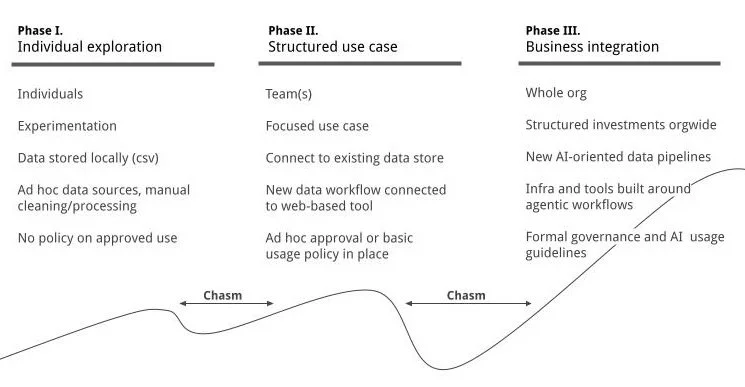
Phase I: Individual exploration
Every organization is at least in Phase I. Even if your organization doesn't allow or encourage AI use, your staff are using it, and you’re in Phase I (see: shadow AI).
AI usage at this point is decentralized and ad hoc. Curious individuals are experimenting on their own, uploading a Word doc or PDF to Claude to accomplish a task more efficiently. There's no connection to back-office systems, and no usage policies to guide staff. And while those individuals will get more productive in some of their tasks, the effort is uncoordinated and not pulling on the most important levers, so overall impact to the organization is low. A recent survey of nonprofits found that "92% are using AI, but 65% describe their use as reactive and individual."[1]. Those are organizations in Phase 1.
Phase II: Structured use case
Organizations enter Phase II when a team gets together to try to solve a specific problem (usually, something that everyone hates doing). This level of coordination requires sign-off from leadership, and there’s typically at least basic usage guidelines in place, even if they’re not well-documented.
On the technical side, rather than uploading files into a web interface, in this phase the team might connect an AI tool to an existing data source—Google Workspace, Airtable, a grant-management system—and create an automated workflow that addresses the pain point.
Building something as a team can be really exciting (“Look at what we made!”) and can definitely improve productivity, but usually the benefits stop with that team. Which means most of the organization remains unaware of any AI usage policy or training, which perpetuates the risk and uncertainty. More importantly, Phase II is still characterized by applying new tools to old problems; with AI you’re replacing a wrench with an electric impact driver—getting the same job done faster, maybe with better quality, but at the core, still doing the same jobs.
Phase III: Business integration
Full business integration will look quite different across organizations, but the defining characteristic is that AI is deeply embedded in how the organization operates—not just technically, but in budgeting, resourcing, operational goals, and governance.
Organizations at this phase aren't just automating workflows and applying new tools—they're designing fundamentally new ways of working that take advantage of AI capabilities. In this phase, instead of using that electric impact wrench, they’ve moved away from using bolts at all, because with AI they can build without needing fasteners.
And this applies across the business: building agentic workflows with meaningful autonomy, reconfiguring roles and teams to reflect how work is being reallocated, and updating performance metrics and incentives to support the new operating reality. This requires a dedicated AI strategy and formal governance—well-documented guidelines on data and use cases, clear decision-making processes, and sustained engagement with staff around capacity building and change management.
Crossing the chasms
Just as we can characterize shared attributes of organizations in each phase, we can distill the key challenges they face in crossing the chasm (with apologies to Geoffrey Moore) to move to the next phase.
Phase I → II is a leadership challenge. The key to making this transition is leadership explicitly endorsing the effort. It doesn't require new headcount or a huge budget, just an explicit commitment to starting the journey and supporting the team to invest its time. Frequently, there are internal champions that are raring to go, and simply need to be unleashed with support and executive aircover.
Like Moore’s Early Adopter, the organizations that stay in Phase I tend to be risk-averse and seek certainty before they’re willing to make the leap. But as I’ve argued elsewhere, that resistance can actually create more risk (e.g. data protection, data privacy) if it leaves the organization without any formal usage guidance.
And as with all organizational transformation, this commitment also means leading by example—if the executive team isn’t dogfooding, nothing will change. Getting leadership engaged, especially if paired with a basic usage policy, is what helps organizations start building the discovery and coordination muscle they’ll need for deeper transformation.
Phase II → III is an investment challenge. As the organization grows its AI maturity in Phase II, it will hit a plateau of minor improvements that increase efficiency, but aren’t creating transformative value. The approach that helped in Phase II is no longer sufficient, as moving into Phase III requires a fundamentally new mindset and reorientation of the organization around AI capabilities: training staff, upgrading technical systems to support AI-native workflows, building out governance bodies and processes, and developing internal metrics to measure success and communicate results. For many organizations, embarking on this level of investment requires a reassessment of the organization’s strategy, signoff from the board, and possibly engagement with partners, grantees, and other external stakeholders.
Most organizations I work with are stuck trying to exit Phase 1 or Phase 2. They usually know where they are, but feel like they lack the technical expertise to take the next step. Yes, AI literacy matters, and the pace of change with the technology makes it genuinely hard to stay current. But the chasms I've described aren't technical in nature, they’re gaps in commitment—and the organizations that successfully move past them are those with leadership willing to make decisions and real investments without waiting for certainty.
[1] The 2026 Nonprofit AI Adoption Report, by Virtuous Software, surveyed 346 nonprofits.